
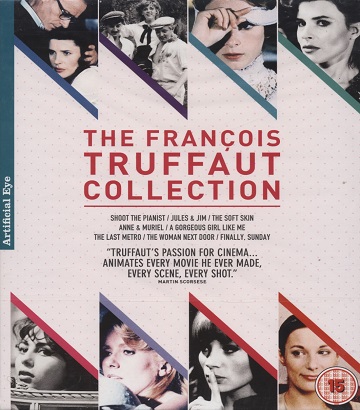
François Truffaut Collection (ej svensk text) (Blu-ray)
0 SEK
Box med åtta klassiska filmer av regissören François Truffaut.
ARTIKELN HAR UTGÅTT
- Fri frakt vid köp över 1000 kr
- Svensk titelSkjut På Pianisten! / Jules Och Jim / Den Lena Huden / Två Systrar Och Claude / En Skön Thej Som Mig / Sista Tåget / the Woman Next Door / Äntligen Söndag!
- OriginaltitelTirez Sur Le Pianiste / Jules Et Jim / La Peau Douce / Les Deux Anglaises Et Le Continent / Une Belle Fille Comme Moi / Le Dernier Métro / La Femme D'à Côté / Vivement Dimanche!
- Alternativ titelShoot the Pianist / Jules And Jim / the Soft Skin / Anne And Muriel / A Gorgeous Girl Like Me / the Last Metro / the Woman Next Door / Finally, Sunday
- SkådespelareCharles Aznavour, Marie Dubois, Nicole Berger, Jeanne Moreau, Oskar Werner, Henri Serre, Jean Desailly, Françoise Dorléac, Nelly Benedetti, Jean-Pierre Léaud, Kika Markham, Stacey Tendeter, Bernadette Lafont, Claude Brasseur, Charles Denner
- RegissörFrançois Truffaut
- Inspelningsår1960-1983
- Bildformat1080p High Definition Widescreen (1.66:1 & 1.33:1)
- LjudLPCM 2.0 / LPCM Mono
- SpråkFranska
- TextningEngelska
- Speltid24 tim 48 min
- GenreBoxar, Drama, Fransk film, World Cinema
- ExtramaterialSHOOT THE PIANIST - Presentation of the film by critic Serge Toubiana - Commentary w. cinematographer Raoul Courtard - Marie Doubois' screen tests - Original theatrical trailer JULES & JIM - Presentation of the film by critic Serge Toubiana - Jeanne Moreau comments on the film - Original theatrical trailer THE SOFT SKIN - Presentation of the film by critic Serge Toubiana - Commentary w. Jean-Louis Richard - Trailer ANNE & MURIEL - Presentation of the film by critic Serge Toubiana, - Commentary w. screen-writer Jean Gruault - Trailer A GORGEOUS GIRL LIKE ME - Truffaut short: Les Mistons ('The Mischief Makers') - Presentation of the short film by critic Serge Toubiana - Commentary of the short film by Claude De Givray - Trailer THE LAST METRO - Presentation of the film by critic Serge Toubiana - Commentary by Gerard Depardieu & film historian Jean-Pierre Azema - Deleted Scene - Original theatrical trailer THE WOMAN NEXT DOOR - Presentation of the film by critic Serge Toubiana - Jeanne Moreau comments on the film - Original theatrical trailer FINALLY, SUNDAY - Presentation of the film by critic Serge Toubiana - Commentary by Jean-Louis Trintignant - Original theatrical trailer
- Releasedatum2014-12-08
- Åldersgräns15 år
- Antal skivor8
- BolagArtificial Eye UK
- OmslagsspråkEngelska
- EAN5021866138404
- Artikelnr14971
Beskrivning
Art.nr: 14971
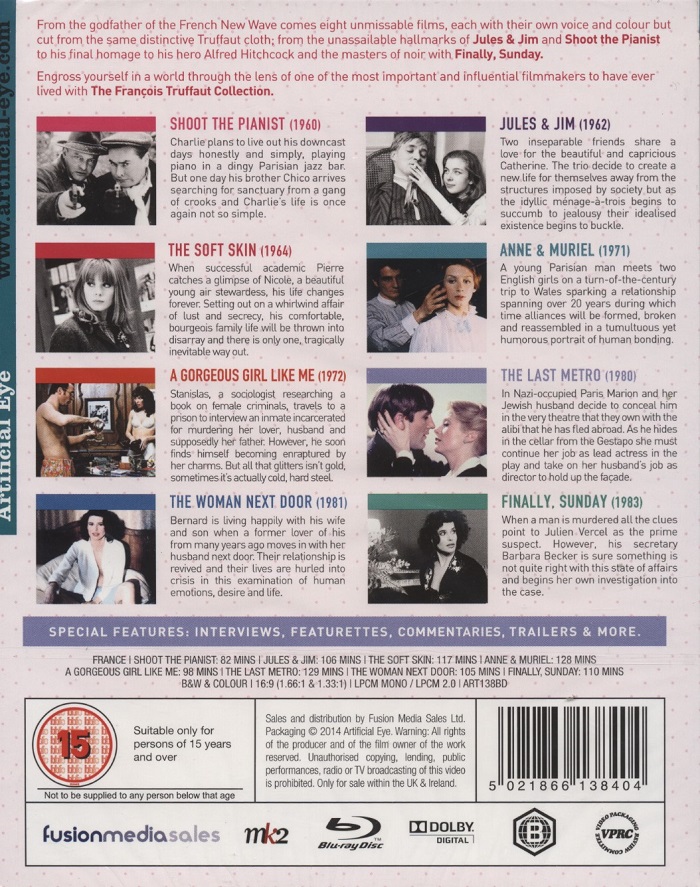
From the godfather of the French New Wave comes eight unmissable films, each with their own voice and colour but cut from the same distinctive Truffaut cloth; from the unassailable hallmarks of Jules & Jim and Shoot the Pianist to his final homage to his hero Alfred Hitchcock and the masters of noir with Finally, Sunday.
Engross yourself in a world through the lens of one of the most important and influential film-
makers to have ever lived with The Franc¸ois Truffaut Collection.
SHOOT THE PIANIST (1960)
Charlie plans to live out his downcast days honestly and simply, playing piano in a dingy Parisian jazz bar. But one day his brother Chico arrives searching for sanctuary from a gang of crooks and Charlie’s life is once again not so simple.
JULES & JIM (1962)
Two inseparable friends share a love for the beautiful and capricious Catherine. The trio decide to create a new life for themselves away from the structures imposed by society but as the idyllic me´nage-a`-trois begins to succumb to jealousy their idealised existence begins to buckle.
THE SOFT SKIN (1964)
When successful academic Pierre catches a glimpse of Nicole, a beautiful young air stewardess, his life changes forever. Setting out on a whirlwind affair of lust and secrecy, his comfortable, bourgeois family life will be thrown into disarray and there is only one, tragically inevitable way out.
ANNE & MURIEL (1971)
A young Parisian man meets two English girls on a turn-of-the-century trip to Wales sparking a relationship spanning over 20 years during which time alliances will be formed, broken and reassembled in a tumultuous yet humorous portrait of human bonding.
A GORGEOUS GIRL LIKE ME (1972)
Stanislas, a sociologist researching a book on female criminals, travels to a prison to interview an inmate incarcerated for murdering her lover, husband and supposedly her father. However, he soon finds himself becoming enraptured by her charms. But all that glitters isn’t gold, sometimes it’s actually cold, hard steel.
THE LAST METRO (1980)
In Nazi-occupied Paris Marion and her Jewish husband decide to conceal him in the very theatre that they own with the alibi that he has fled abroad. As he hides in the cellar from the Gestapo she must continue her job as lead actress in the play and take on her husband’s job as director to hold up the fac¸ade.
THE WOMAN NEXT DOOR (1981)
Bernard is living happily with his wife and son when a former lover of his from many years ago moves in with her husband next door. Their relationship is revived and their lives are hurled into crisis in this examination of human emotions, desire and life.
FINALLY, SUNDAY (1983)
When a man is murdered all the clues point to Julien Vercel as the prime suspect. However, his secretary Barbara Becker is sure something is not quite right with this state of affairs and begins her own investigation into the case.